
You’ve invested in SEO, watched the weeks tick by, and wondered why your phone isn’t ringing yet. That frustration is real, and you’re not alone. Most local business owners expect Google to respond within days of launching a new website or updating their content. The truth is more nuanced, and understanding it can save you from chasing shortcuts that actually push your rankings backward. This guide breaks down exactly why SEO results take time, what realistic timelines look like for Boca Raton businesses, and what you can do right now to move faster without taking risks.
Table of Contents
- Why SEO isn’t instant: The search engine process explained
- What slows SEO: Competition, technical limits, and implementation delays
- How long will it take? Realistic SEO timelines for Boca Raton businesses
- What you can do to move SEO faster (and avoid costly mistakes)
- The hidden upside of SEO’s slow pace: Building lead quality and business durability
- Get expert help to accelerate your Boca Raton SEO results
- Frequently asked questions
Key Takeaways
| Point | Details |
|---|---|
| SEO is a long game | Real SEO gains in Boca Raton typically require several months to become visible. |
| Process matters | Crawling, indexing, and ranking evaluations all take time and can’t be rushed. |
| Beware of shortcuts | Quick fixes may cause long-term damage and delay sustainable SEO results. |
| Competition counts | The strength of your competitors and the complexity of your site affect how long SEO takes. |
| Actions accelerate results | Staying proactive with content and technical fixes can help you achieve rankings faster. |
Why SEO isn’t instant: The search engine process explained
Now that we’ve addressed expectations, let’s dissect the real reason SEO results take weeks or months to appear.
Most business owners assume that once you optimize a page, Google sees it immediately. That’s not how it works. Google runs a sequential, multi-stage process before any change in rankings becomes visible. Each stage adds time, and none of them can be skipped.
Here’s the basic flow Google follows every time it evaluates a page:
| Stage | What happens | Typical timeframe |
|---|---|---|
| Crawling | Google sends bots (called Googlebot) to discover and visit your pages | Days to weeks |
| Rendering | Google processes your page’s code and visual content | Up to several weeks |
| Indexing | Google decides whether the page is worth storing in its database | Days to weeks after rendering |
| Ranking evaluation | Google compares your page against competitors using 200+ signals | Weeks to months |
| Behavioral signals | Google tracks real user behavior (clicks, bounce rate, dwell time) | Several months |
As you can see, SEO takes time primarily because of sequential search engine processes like crawling, indexing, rendering, and ranking evaluation, all of which require weeks to months for Google to observe meaningful behavioral signals. That’s not a flaw in the system. It’s Google working to make sure it only ranks content that genuinely earns its position.
“Think of it this way: earning a top Google ranking is like building a reputation in a new neighborhood. It doesn’t happen because you moved in last Tuesday. It happens because neighbors have seen your work, trusted your word, and recommended you over time.”
The SEO results timeline you should realistically expect reflects every step in this chain. Even a perfectly optimized page can sit unranked for weeks simply because Googlebot hasn’t revisited it yet. This is why patience, combined with the right strategy, is the actual competitive advantage.
What slows SEO: Competition, technical limits, and implementation delays
Understanding the process is one part, but what actually slows it down even more?

Even after Google crawls and indexes your site, several real-world factors can drag the timeline out significantly. Knowing what they are helps you prioritize the right fixes.
The three biggest slowdown factors:
-
Competition from established sites. Outperforming established competitors is one of the hardest obstacles a newer or lower-authority website faces. Businesses that have been ranking for years have built up thousands of backlinks, consistent traffic signals, and deep topical authority. Breaking into those positions takes time and consistent effort.
-
Technical website issues. JavaScript rendering delays can slow Google’s processing by up to nine times compared to standard HTML pages. Index bloat, which is when your site has too many low-quality or duplicate pages, wastes what’s called your “crawl budget,” meaning Google spends less time on your important pages. These issues silently kill your chances of ranking quickly.
-
Implementation delays. One of the most overlooked causes of slow SEO is the gap between planning and execution. Technical fixes, content creation, and developer changes can take weeks or even months before they’re live on your site, and then Google has to recrawl and reassess everything before you see any movement. Every day a fix sits in a backlog is a day your timeline extends.
The technical SEO explained side of things includes all the behind-the-scenes factors that affect how efficiently Google crawls and processes your website. Crawl budget, page speed, structured data, and mobile optimization all play a role that most business owners never see.
Pro Tip: Schedule a technical audit every 90 days at a minimum. Even a small site accumulates issues over time, such as broken links, duplicate meta descriptions, or slow-loading images, that eat into your SEO momentum without you realizing it.
In a competitive market like Boca Raton, where you’re going up against established local businesses and national chains with local presences, these technical details matter more than most people think. A clean, fast, well-structured site gives Google every reason to prioritize your content over a competitor’s.
How long will it take? Realistic SEO timelines for Boca Raton businesses
With the barriers clear, how long should you actually expect to wait for Google to move the needle in Boca Raton?
The honest answer is that it depends on your starting point, your competition, and how aggressively you implement your strategy. But there are real benchmarks you can use to set expectations.
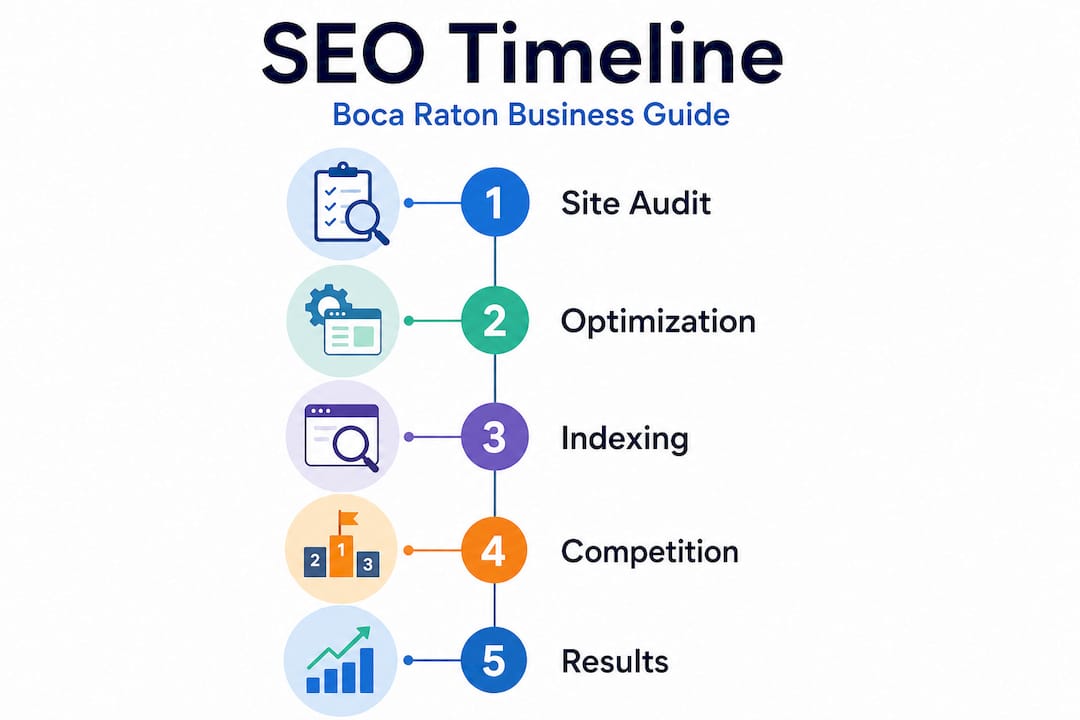
Comparison of SEO timeline scenarios for local Boca Raton businesses:
| Scenario | Timeframe | What drives it |
|---|---|---|
| Best case (low competition) | 2 to 4 months | Targeting niche local keywords with little competition |
| Average local business | 3 to 6 months | Moderate competition, consistent content, regular updates |
| Challenging (high competition) | 6 to 12 months | Competing with established brands, high-traffic keywords |
| Brand new website | 9 to 18 months | Building authority from scratch |
For local businesses in Boca Raton, measurable results typically appear within three to six months, with faster movement possible in two to four months for low-competition terms. Stable, lasting rankings in competitive niches usually require six to twelve months of sustained effort. The outliers are real too: aggressive local campaigns have produced results like 6X visibility gains in six months and 347% ROI in just 90 days when the strategy is precise, well-funded, and executed without delay.
A realistic SEO results journey, step by step:
- Month 1: Technical audit completed, on-page optimization begins, Google Business Profile updated, initial keyword targeting set.
- Month 2: Content published, citations built, backlinks outreach initiated, crawl errors resolved.
- Month 3: Google begins re-indexing updated pages, early ranking movement visible for low-competition terms.
- Month 4 to 6: Steady ranking improvements across primary keywords, local map pack visibility grows, lead inquiries increase.
- Month 6 to 12: Rankings stabilize in top positions, compounding traffic builds, high-value buyer-intent keywords become achievable.
Use the local SEO checklist to make sure you’re covering every step in the right order. And if you want a complete framework, the local optimization guide walks you through everything from Google Business Profile setup to citation building and content strategy.
The key takeaway here is that SEO rewards consistency. Business owners who treat it like a sprint often stall out. Those who commit to the full process are the ones who end up dominating page one for the searches that actually generate revenue.
What you can do to move SEO faster (and avoid costly mistakes)
Now that you know the timeline, let’s focus on what you can actually do to achieve results as quickly as Google allows.
There are specific actions that move the needle faster, and just as importantly, there are traps that look like shortcuts but cost you months of progress.
Actions that speed up your SEO results:
- Fix critical technical issues first. Slow page load speed, mobile usability problems, and broken internal links signal to Google that your site is not well maintained.
- Publish content that directly answers buyer-intent questions. Think “best HVAC company in Boca Raton” or “emergency plumber near me” rather than generic topics. Quality content targeted at what buyers are actually searching for converts visitors into leads.
- Claim and fully optimize your Google Business Profile. For local searches, this is often the fastest-moving piece you can control.
- Build consistent local citations across directories like Yelp, Angi, and industry-specific platforms. Inconsistent name, address, and phone number information confuses Google and hurts your local rankings.
- Earn backlinks from credible local sources such as local news sites, chambers of commerce, and community blogs. Each quality backlink functions like a vote of trust in your site’s authority.
Mistakes that silently slow you down:
- Keyword stuffing. Cramming keywords into every sentence doesn’t fool Google anymore. It hurts readability and signals low-quality content.
- Buying cheap backlinks. Low-quality links from spammy sites can trigger manual penalties that are extremely difficult to recover from.
- Ignoring implementation delays. Letting SEO recommendations sit unactioned for weeks is one of the most common and costly mistakes local business owners make.
- Publishing thin content. Pages with fewer than 400 to 600 words that don’t thoroughly cover a topic rarely rank well in competitive local markets.
Pro Tip: Set up Google Search Console (it’s free) and check it weekly. Watch for coverage errors, manual actions, and your average ranking position for target keywords. Consistent monitoring lets you catch problems before they compound into major setbacks.
The fastest-moving local SEO campaigns have one thing in common: they treat execution speed as a competitive advantage. Use these SEO content tips to sharpen your content strategy, and pair them with the website optimization tips that address the technical side. Both sides of the equation need to work together.
The hidden upside of SEO’s slow pace: Building lead quality and business durability
We’ve covered the mechanics and practical strategies. Now let’s look at why the slower path is almost always more valuable.
Here’s an opinion you won’t hear often: the fact that SEO takes time is actually one of its greatest strengths for local business owners. It acts as a natural filter that keeps low-commitment competitors from simply buying their way to the top and disappearing a month later.
When a business earns a top Google ranking through consistent optimization, quality content, and genuine authority signals, that position is sticky. It doesn’t evaporate the moment you pause your credit card. Compare that to paid advertising, where your visibility drops to zero the second your budget runs out. SEO builds long-term growth that operates like an asset on your balance sheet, not an expense line that resets monthly.
There’s another angle that rarely gets discussed: lead quality. People who find your business through organic search have usually already decided they want a service. They searched, compared, clicked your listing, read your content, and reached out. That’s a buyer, not a browser. Paid ads attract both. Organic rankings, especially for high buyer-intent keywords, attract people who are further along in the decision process.
The business owners who get frustrated with slow SEO and give up are often the same ones who later admit their highest-value long-term clients came from organic search. Patience isn’t passive here. It’s a strategic decision to invest in a channel that compounds over time rather than one that resets every 30 days. When we work with clients in Boca Raton, the most dramatic revenue shifts we see always come after month six, not before. The early months are foundation-building. The later months are when that foundation starts paying off consistently.
Get expert help to accelerate your Boca Raton SEO results
Ready to see faster progress? Here’s how Boca Raton business owners can take the next step.
Understanding why SEO takes time is valuable, but knowing how to execute correctly from day one is what separates businesses that see results in three months from those still waiting at month twelve. Expert-guided site audits identify the technical issues slowing Google down before they cost you weeks of lost ranking potential. Targeted local strategies built around high buyer-intent keywords put your business in front of people who are ready to spend money, not just browse.

Start with the local SEO checklist to benchmark where you stand right now. Then use the local optimization guide to build a prioritized action plan tailored to the Boca Raton market. If you want a clear picture of how your site is currently performing, request a custom SEO report and we’ll show you exactly where the opportunities are and what it will take to rank where your buyers are searching.
Frequently asked questions
What is the fastest way to see SEO improvements for a local Boca Raton business?
Quick results often come from optimizing your Google Business Profile, fixing major website issues, and targeting low-competition local keywords. Local businesses can see measurable movement in as little as two to four months when these foundational elements are in place.
Will buying backlinks or stuffing keywords make SEO work faster?
No. These shortcuts often backfire and risk Google penalties that set your rankings back by months or longer, causing far more damage than the short-term gain is worth.
How do technical website issues delay SEO results?
Technical problems like slow page speed or unoptimized code cause crawl budget waste and indexing delays, meaning Google takes longer to recognize and rank your updated content.
Is there any way to guarantee first-page Google rankings in a set timeframe?
No legitimate SEO provider can guarantee specific ranking positions by a fixed date because competition levels and algorithm updates are always changing.
How do I know if my SEO is on the right track?
Track your rankings, organic clicks, and lead inquiries using Google Search Console, and compare your progress month over month against the realistic timeline benchmarks outlined in this guide.