
Most Florida medical practices already have a website. Many have posted a few blog articles, set up a basic Google listing, and called it done. The problem? 77% of patients use search engines before booking a healthcare appointment, yet the majority of practices remain invisible because their SEO approach is generic, outdated, or both. In a state as competitive as Florida, where patients in Miami, Boca Raton, and Tampa have dozens of options within a short drive, effective SEO for medical practices is not optional. It is the difference between a full appointment book and an empty waiting room.
Table of Contents
- Understanding SEO challenges unique to medical practices in Florida
- Core SEO strategies for medical practices to improve online visibility and patient trust
- Technical and compliance essentials: HIPAA-compliant analytics and website optimization for Florida medical SEO
- Advanced tactics for sustainable SEO success: content authority, schema, and multi-location management
- Why most Florida medical SEO fails and how to avoid it
- How reputable SEO services empower Florida medical practices to grow
- Frequently asked questions
Key Takeaways
| Point | Details |
|---|---|
| SEO captures patient intent | 77% of patients search online before booking, so effective medical SEO directly drives patient acquisition. |
| Reviews boost rankings | 94% of patients choose providers based on online reviews, making reputation management crucial for local SEO. |
| HIPAA compliance is mandatory | Using non-compliant analytics risks hefty fines; only HIPAA-compliant tools with BAAs should be used. |
| Local SEO focuses on proximity | Optimizing Google Business Profile, location pages, and local keywords targets nearby patients with high booking intent. |
| Differentiation beats templates | Florida medical practices succeed by tailoring SEO strategies to their unique patient base, not using generic marketing templates. |
Understanding SEO challenges unique to medical practices in Florida
Healthcare SEO is not like SEO for a restaurant or a law firm. Google places medical content in a category called YMYL, which stands for “Your Money or Your Life.” Because of this classification, medical content faces stricter scrutiny than almost any other industry. Misinformation about a condition or treatment can cause real harm, so Google holds these pages to a significantly higher standard of accuracy, expertise, and credibility.
Florida compounds this challenge. You are not competing with a handful of local clinics. You are competing against large hospital systems, urgent care chains, and nationally backed specialty groups who all invest heavily in digital marketing for doctors. A practice in Coral Springs or Fort Lauderdale that relies on a generic healthcare website template will simply not rank for high-intent patient searches.
The three things Google looks for in medical content are often described as E-E-A-T:
- Experience: Has a real clinician contributed to or reviewed this content?
- Expertise: Does the content demonstrate actual medical knowledge?
- Authoritativeness: Do credible external sources reference this practice?
- Trustworthiness: Is the site secure, accurate, and free of misleading claims?
“Cookie-cutter digital marketing fails medical practices by lacking differentiation in competitive Florida markets,” according to Forbes Agency Council contributors who stress patient acquisition strategy over off-the-shelf templates.
Understanding these fundamentals is the first step. The good news is that when you meet these standards consistently, you build a competitive advantage that is very hard for a rival practice to undo overnight. Now that you understand the unique demands of medical SEO in Florida, let’s explore critical strategies to improve your practice’s online visibility.
Core SEO strategies for medical practices to improve online visibility and patient trust
This is where real results start. The following strategies are drawn from what actually moves the needle for Florida medical clinics, not what sounds good in theory.
1. Build your Google Business Profile like it is your most valuable asset
Because, in local search, it is. Local SEO for healthcare depends heavily on a fully completed Google Business Profile with consistent name, address, and phone data (called NAP), along with genuine patient reviews and location-specific website pages. Fill in every available field: services, insurance accepted, hours for each day, photos of your office and staff, and a thorough description using keywords your patients actually type.
2. Make patient reviews a system, not an afterthought
A staggering 94% of prospective patients choose healthcare providers based on online reviews. That number alone should change how your front desk team handles post-visit follow-up. Build a review request workflow into your patient communication tools. Ask for reviews via text or email within 24 hours of a visit. Respond to every review, positive or negative, to show Google and future patients that you are engaged and accountable.

3. Create individual pages for every service and location
This is one of the highest-ROI moves in healthcare SEO strategies. One generic “Services” page does not rank for anything specific. A dedicated page titled “Knee pain treatment in Boca Raton” targets a precise patient search and answers their exact question. Multiply this across every service you offer and every city you serve, and you can own a large portion of the local search results. Review our local search optimization strategies to understand how this works in practice.
4. Use schema markup built for healthcare providers
Schema markup is structured data you add to your website code to help Google understand exactly who you are and what you do. Think of it as a fact sheet you hand directly to the search engine. Medical schema types like MedicalClinic, Physician, LocalBusiness, and FAQ give Google richer information, including your address, hours, doctors, and reviews, and can trigger enhanced search result features called rich results that increase your click-through rate.
5. Target long-tail keywords that match Florida patient intent
Broad keywords like “orthopedic surgeon” are competitive and expensive to rank for. Long-tail phrases like “ACL reconstruction recovery specialist in West Palm Beach” have lower competition and higher conversion rates because they match exactly what a ready-to-book patient types. Use our local SEO checklist for Florida to identify the right keyword targets for your specific specialty and service area.
Pro Tip: Before publishing any new service page, run the target phrase through Google and look at the “People also ask” section. Those questions are free keyword research, and answering them directly on your page improves your chances of appearing in featured snippets.
| SEO tactic | Difficulty | Speed to results | Patient impact |
|---|---|---|---|
| Google Business Profile optimization | Low | Fast (2 to 4 weeks) | High |
| Review acquisition system | Low | Medium (1 to 3 months) | Very high |
| Individual service and location pages | Medium | Medium (2 to 4 months) | High |
| Schema markup implementation | Medium | Fast once implemented | Medium to high |
| Long-tail keyword content strategy | Medium | Longer (3 to 6 months) | Very high |
Technical and compliance essentials: HIPAA-compliant analytics and website optimization for Florida medical SEO
Medical website optimization goes beyond content. The technical layer of your site directly affects how you rank and, critically, whether you are operating within legal boundaries.
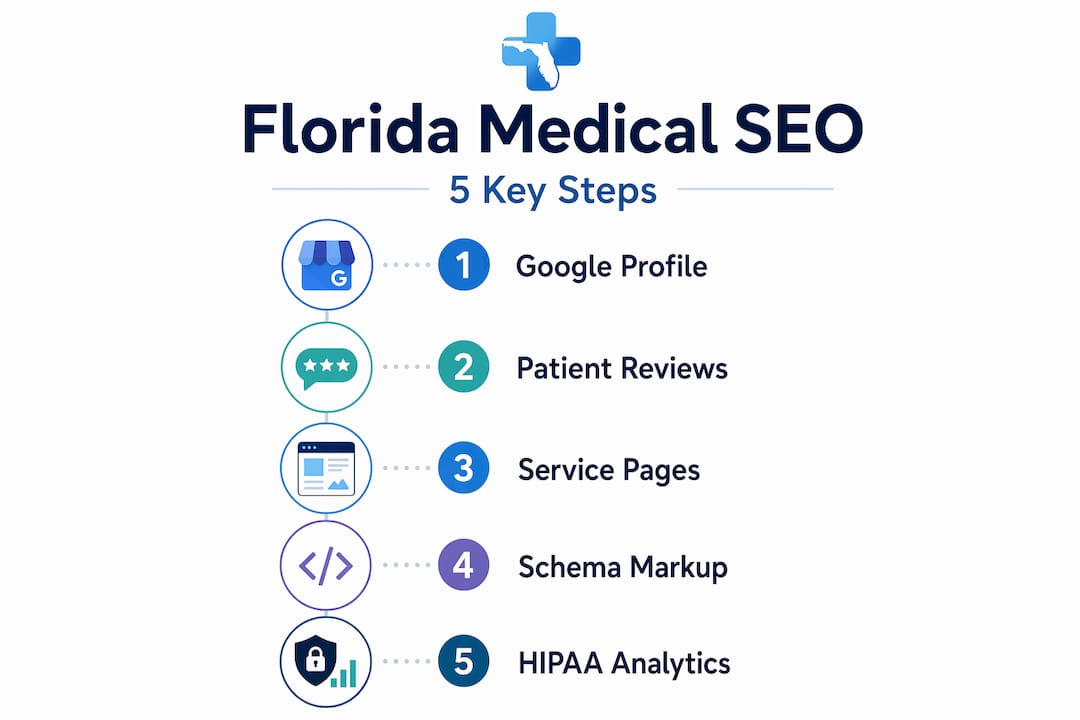
The compliance issue most Florida practices miss is their analytics setup. Google Analytics 4 is not HIPAA-compliant in healthcare contexts where patient health intent can be inferred, and HIPAA violation penalties averaged $450,000 in 2026. Using it on a medical website without a Business Associate Agreement (BAA) is a serious liability. Alternatives like Matomo (self-hosted), Piwik PRO, or healthcare-specific platforms with signed BAAs give you the tracking data you need without the risk.
Beyond compliance, the core technical factors that affect your rankings include:
- Page speed: Your website should load in under 3 seconds. Google measures this and penalizes slow sites, particularly on mobile. Test your pages regularly with PageSpeed Insights.
- Mobile optimization: More than 60% of patient searches happen on smartphones. Your site must display correctly, load quickly, and make it easy to call or book from a mobile screen.
- HTTPS security: An SSL certificate is non-negotiable for both Google rankings and patient trust. A patient who sees a “Not Secure” warning in their browser will leave immediately.
- Server-side tracking: Implementing tracking at the server level instead of through browser cookies helps prevent Protected Health Information (PHI) from leaking into third-party analytics tools.
Pro Tip: Set up Google Search Console (free and privacy-safe) and review your “Core Web Vitals” report monthly. This report tells you exactly which pages are underperforming technically, so you can fix them before they cost you rankings. See our breakdown of SEO technical best practices for a step-by-step framework.
With a secure, optimized foundation in place, you can apply advanced SEO techniques for sustainable growth and authority.
Advanced tactics for sustainable SEO success: content authority, schema, and multi-location management
Ranking consistently in Florida’s medical markets over the long term requires going deeper than the basics. This is where practices that invest seriously pull ahead of the field and stay there.
Clinician-authored, authoritative content. Google’s post-2025 core updates hit thin or uncited medical content hard. Link every clinical claim to NIH or CDC sources and include clinician bylines to meet YMYL scrutiny and maintain rankings. A page written by your practice’s board-certified physician, citing peer-reviewed research, carries far more weight than anonymous blog content.
Advanced schema for Florida-specific advantages. Most practices use basic LocalBusiness schema. Going further with Physician or MedicalBusiness markup that includes the usNPI (National Provider Identifier) field and the medicalSpecialty property gives Florida-specific local search signals that very few competitors are using. This is the kind of detail that separates a page ranked #3 from a page ranked #1.
Location page management for multi-site practices. If you operate more than one location, each office needs its own dedicated page. That page should list the specific providers at that location, the services available there, local phone number, hours, and a unique description of the community it serves. See how we approach multi-location SEO management for Florida healthcare clients.
| Advanced tactic | Who benefits most | Ranking impact |
|---|---|---|
| Clinician-authored content with citations | All Florida medical practices | Very high post-2025 |
| usNPI and medicalSpecialty schema | Specialists and multi-physician groups | High for local pack rankings |
| Unique location pages per branch | Multi-location practices | Very high for each service area |
| NAP consistency across directories | All practices | High, prevents ranking penalties |
Pro Tip: Build a simple content calendar where each month one clinician at your practice reviews and updates at least two existing website pages. Fresh, expert-verified content signals ongoing authority to Google without requiring you to constantly publish brand new articles.
Having covered advanced SEO strategies, let’s explore an expert perspective on common pitfalls and winning approaches for Florida medical practices.
Why most Florida medical SEO fails and how to avoid it
After working with medical clients across South Florida, we have seen the same failure pattern repeat itself. A practice buys a healthcare website package. The vendor loads it with pre-written content about common conditions. The Google Business Profile is partially filled out. A few blog posts go up and then stop. Six months later, the phone is not ringing more than it was before, and the practice owner concludes that “SEO doesn’t work for us.”
The real problem is that the SEO was never built around patient acquisition. Rankings are a means to an end. The end is a patient calling your office, booking an appointment, and choosing your practice over the one down the street. Generic approaches that fail to differentiate medical practices in saturated Florida markets cannot achieve that outcome, no matter how many pages they publish.
What actually works is aligning your SEO with local patient behavior. A practice in Broward County treating a large Spanish-speaking population should have bilingual pages targeting Spanish-language search queries. A concierge practice in Palm Beach targeting high-income patients should rank for premium, outcome-focused keywords, not just insurance-driven terms. A pediatric group in Orlando should target parent search behavior, which skews heavily toward mobile and late-night searches.
The other failure point is compliance neglect. One HIPAA violation from a leaky analytics setup can cost more than years of SEO investment. Durable success comes from building on a foundation of compliant tracking, verified clinical content, and real patient engagement, not shortcuts. Learn more about common Florida SEO pitfalls and lessons we have observed firsthand.
How reputable SEO services empower Florida medical practices to grow
If this guide has shown you anything, it is that effective SEO for medical practices in Florida requires a very specific combination of local market knowledge, compliance awareness, technical execution, and patient-focused content strategy. Most practices do not have the internal resources to do all of that consistently at a high level, and that is exactly where the right SEO partner changes everything.

We specialize in helping Florida medical practices win the high-intent patient searches that turn directly into booked appointments. Our process starts with a thorough audit using our local SEO checklist for Boca Raton businesses as a baseline, then expands to cover every factor that affects your rankings and lead flow. We focus on SEO lead generation with high-intent leads because ranking for terms that do not convert is a waste of your marketing budget. Every strategy we implement is tracked through SEO performance reports that are built around HIPAA-compliant data so you know exactly what is working without any compliance risk. Ready to stop being invisible online? Let’s build something that actually fills your schedule.
Frequently asked questions
Why is SEO important specifically for medical practices in Florida?
Florida’s medical market is one of the most competitive in the country, and 77% of patients use search engines before booking an appointment, which means being invisible online directly costs your practice revenue.
How do online reviews affect my medical practice’s SEO and patient trust?
Reviews are a primary ranking factor in local search and a major trust signal for new patients. 94% of prospective patients select their healthcare provider based on online reputation, making consistent review acquisition essential.
What are the key compliance considerations for tracking patient-related SEO data?
You must use analytics platforms that have signed BAAs and are built for healthcare privacy. Google Analytics 4 cannot be used where patient health intent is inferable, with 2026 HIPAA penalties averaging $450,000 per violation.
How does local SEO differ from general SEO for medical practices?
Local SEO targets geographic patient searches and focuses on Google Maps rankings, proximity signals, and location-specific content. Local healthcare SEO also weighs NAP consistency, reviews, and proximity more heavily than standard organic ranking factors.
What advanced SEO tactics are most effective for multi-location medical practices?
Each location needs its own dedicated page with unique provider listings, services, and locally relevant content. Layering medical schema markup with usNPI data and location-specific structured data builds local search authority for every branch independently.