
Most small business owners in Boca Raton think page speed SEO is about hitting a perfect score on a Google speed test. Run the test, get a green number, move on. That belief costs real leads every single day. Page speed SEO is really about how quickly a webpage loads and becomes usable for an actual visitor on their actual device, and Google measures that through Core Web Vitals pulled from real-world user experiences. When your most important pages load slowly for real visitors, those visitors leave before they ever fill out a contact form or call your business.
Table of Contents
- What is page speed SEO?
- How Google measures page speed: Core Web Vitals
- Why does page speed matter for Boca Raton lead generation?
- Common mistakes and quick wins for improving page speed
- Our perspective: The uncomfortable truth about page speed SEO
- Next steps: Elevate your Boca Raton site’s page speed and leads
- Frequently asked questions
Key Takeaways
| Point | Details |
|---|---|
| Focus on real metrics | Google prioritizes field Core Web Vitals from actual user visits, not just lab scores. |
| Optimize high-intent pages | Improving speed on conversion-focused pages boosts lead generation and business growth. |
| Avoid common pitfalls | Test your site using real-user tools and fix issues like slow images and heavy scripts. |
| Know your impact | Faster sites reduce bounce rates and increase conversion opportunities for small businesses. |
What is page speed SEO?
Page speed SEO is the practice of optimizing how fast your webpages load and respond so that both visitors and Google rank your site more favorably. It is not about passing a single automated test. According to the Backlinko Page Speed Guide, page speed refers to how quickly a specific webpage loads and becomes usable for visitors, and in SEO it is closely tied to Google’s Core Web Vitals metrics.
Think of it this way: a lab speed test is like a test drive on an empty parking lot. Core Web Vitals are the real-world highway experience that actually matters.
Here is why this distinction matters for your business:
- A page can score 90 or above on PageSpeed Insights while still loading slowly for mobile users on a 4G connection in Boca Raton.
- Google’s ranking algorithm uses field data, meaning performance measured from real users visiting your site, not simulated tests run from a data center.
- Slow pages frustrate visitors. Frustrated visitors do not become leads.
- Fast pages keep visitors engaged long enough to read your offer and take action.
“Chasing a PageSpeed Insights score without understanding field performance is one of the most common and costly mistakes we see small business websites make.”
Before you start making technical changes, use our website optimization checklist to make sure you are targeting the right improvements from the start. Knowing what to fix before you start saves you time and money.
The bottom line: page speed SEO is user experience measured in milliseconds. Every millisecond counts when a potential customer is deciding whether to stay on your site or hit the back button.
How Google measures page speed: Core Web Vitals
Google does not use a single speed score to rank your website. It uses a set of three specific metrics called Core Web Vitals, and it measures them from real visitors browsing your site. This data comes from the Chrome User Experience Report, known as the CrUX dataset. According to the CrUX Report, the three Core Web Vitals are LCP, INP, and CLS, and they form the foundation of Google’s “good” experience categories.
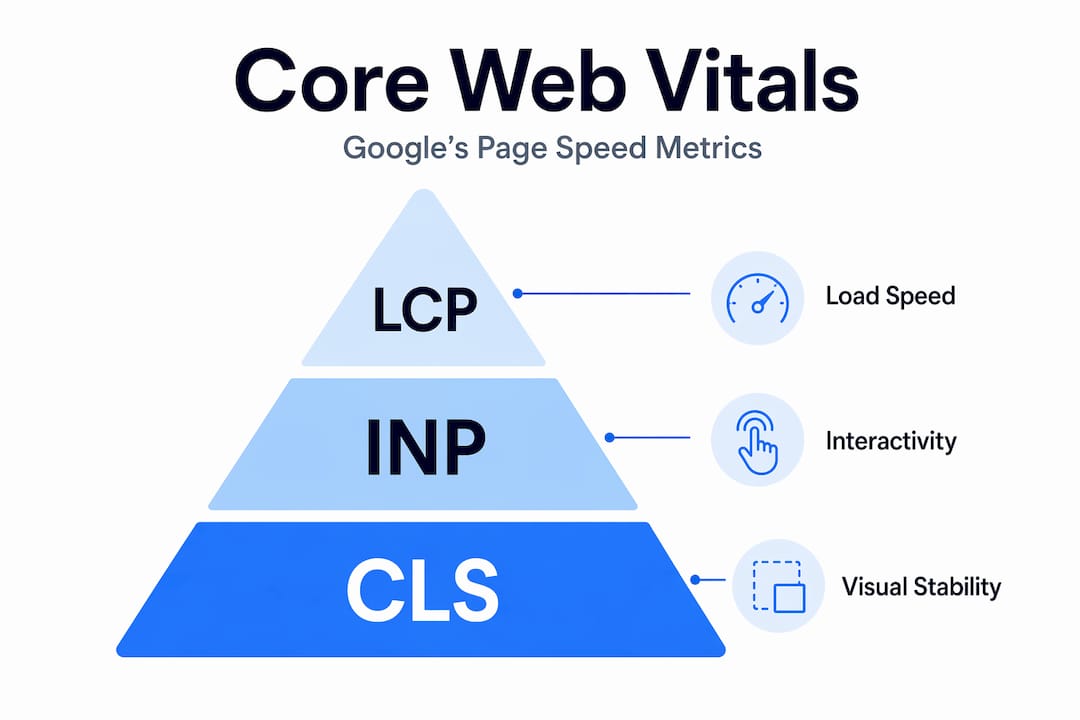
Here is what each metric actually measures:
LCP (Largest Contentful Paint): How long it takes for the largest visible element on your page to load. This is usually your hero image or main headline. Google considers anything under 2.5 seconds to be “good.”
INP (Interaction to Next Paint): How quickly your page responds when a user clicks a button, fills out a form, or taps a link. This replaced the older FID metric in 2024. A good INP score is under 200 milliseconds.
CLS (Cumulative Layout Shift): How much your page layout jumps around while loading. You have experienced CLS when you try to tap a button and it suddenly moves because an ad loaded above it. A good CLS score is under 0.1.
Here is a clear comparison between what lab scores show versus what field Core Web Vitals actually measure:
| Metric type | What it measures | Data source | Affects Google ranking? |
|---|---|---|---|
| Lab score (PageSpeed Insights) | Simulated performance on a test device | Google’s servers | No, indirectly |
| LCP (field) | Real load time for real visitors | CrUX user data | Yes, directly |
| INP (field) | Real interactivity for real visitors | CrUX user data | Yes, directly |
| CLS (field) | Real layout stability for real visitors | CrUX user data | Yes, directly |
Critically, the CrUX data confirms that in Google SEO, page speed is not about chasing a single PageSpeed Insights score. The relevant signals are Core Web Vitals measured from real user experiences in the field.
Here is how to review your Core Web Vitals in four steps:
- Go to Google Search Console and click on “Core Web Vitals” under the Experience section.
- Check both mobile and desktop reports separately, since mobile is often significantly worse.
- Look for pages flagged as “Poor” or “Needs improvement” first, not just aggregate scores.
- Cross-reference those flagged pages against your highest-traffic and highest-converting pages.
Pro Tip: Do not just look at your homepage in Search Console. Many small business websites have their service pages and landing pages performing far worse than the homepage because those pages get less attention from developers. Those are often where your leads come from.
You can also request a full SEO report to see exactly how your site’s performance compares and where the biggest opportunities for improvement exist.
Why does page speed matter for Boca Raton lead generation?
Here is the real-world connection that most agencies skip over: page speed directly impacts whether visitors convert into leads. A slow page does not just hurt your Google ranking. It kills conversions before anyone ever sees your offer.
Consider a Boca Raton plumbing company with a beautiful website. Their homepage loads in 4.2 seconds on mobile. A homeowner searches for emergency plumbing repair, clicks the ad or organic result, waits for the page to load, and then leaves to find a competitor whose page loads in 1.8 seconds. That is a lost lead that no amount of great copywriting could have saved.

High-intent pages are the pages where visitors are ready to contact you, request a quote, or make a purchase. These are your homepage, service pages, and any landing pages tied to specific campaigns. According to the Backlinko Page Speed Guide, small business and marketing teams should prioritize page speed improvements on high-intent pages including home, service pages, and landing pages, along with the key conversion paths such as quote requests, contact forms, and checkout flows.
Here is the data that shows why this matters:
| Page load time | Average bounce rate | Estimated conversion impact |
|---|---|---|
| Under 2 seconds | 9% | Baseline: strong conversion |
| 3 seconds | 38% | Moderate drop in leads |
| 5 seconds | 53% | Significant lead loss |
| 10 seconds | 90%+ | Nearly zero conversions |
These numbers tell a clear story. Every second of delay compounds your bounce rate and shrinks your potential lead pool.
Here are the actions that directly improve lead outcomes through better page speed:
- Compress and properly size images on all high-intent pages, especially hero images and above-the-fold visuals.
- Remove or defer non-essential scripts that delay the page from becoming interactive, particularly on contact and service pages.
- Use a fast web host that delivers consistent server response times under 200 milliseconds.
- Implement lazy loading for images below the fold so the critical top section loads first.
- Enable browser caching so repeat visitors experience near-instant loading.
- Minimize third-party scripts like chat widgets and tracking pixels that slow down INP scores.
Pro Tip: Prioritize your contact page, quote request page, and top service pages for speed fixes first. These pages are where leads are born. Fixing your blog or about page first is a common distraction that delays real results.
Understanding your SEO results timeline is also important. Page speed improvements can show ranking and conversion benefits within weeks, especially when you fix the pages with the worst field Core Web Vitals first.
Common mistakes and quick wins for improving page speed
Small business websites in Boca Raton tend to make the same speed mistakes repeatedly. Knowing what they are puts you ahead of most of your competitors right now.
Common mistakes that slow your pages:
- Uploading full-resolution images directly from a camera or design tool without compressing them
- Using outdated or bloated page builder plugins that add unnecessary code to every page
- Running too many tracking scripts and third-party widgets simultaneously
- Not enabling a content delivery network (CDN) to serve assets from servers closer to visitors
- Using cheap shared hosting that throttles server response times during peak traffic hours
- Not minifying CSS and JavaScript files, meaning browsers have to process extra whitespace and comments
- Loading large video files directly instead of embedding them from YouTube or Vimeo
Quick wins you can act on today:
- Run your homepage and top service pages through Google Search Console’s Core Web Vitals report and identify specific issues flagged there.
- Use a tool like TinyPNG or Squoosh to compress images before uploading them to your site. Image compression alone can reduce page weight by 40 to 60 percent in many cases.
- Switch to a managed WordPress host or a faster hosting tier if your server response time exceeds 200 milliseconds.
- Install a caching plugin if you use WordPress. WP Rocket and LiteSpeed Cache both dramatically reduce load times for most small business websites.
- Audit your installed plugins and remove any that are inactive or redundant.
The CrUX Report makes an important point here: optimization should target user experience metrics like LCP, INP, and CLS rather than optimizing for a single lab score. A page can look fast in a local test while failing real-user thresholds. This is the trap that catches most business owners and even many SEO agencies.
“The most valuable page speed work happens when you stop optimizing for automated test reports and start optimizing for the real visitors who are deciding whether to contact you or your competitor.”
For a complete roadmap that ties page speed into your broader search strategy, review the SEO best practices guide we have put together for Boca Raton businesses. And if your pages are converting but not ranking, strong SEO copywriting strategies combined with faster load times create a powerful one-two punch for attracting high-intent leads.
Pro Tip: Test your pages with Google Search Console’s field data and PageSpeed Insights’ “Field Data” tab, not just the “Lab Data” tab. If there is not enough real-user data yet for your site, Google will not show field data, which itself tells you something important about your traffic volume.
Our perspective: The uncomfortable truth about page speed SEO
Here is something most agencies will not tell you: the majority of page speed audits delivered to small business owners focus entirely on the wrong thing. They show you a score. They celebrate a green circle. They move on. Meanwhile, your actual visitors on actual mobile devices are still waiting three, four, or five seconds for your service pages to load.
We have seen websites with PageSpeed Insights scores in the 90s that had terrible Core Web Vitals field data because the site had low traffic and Google was filling in estimated data rather than real user measurements. And we have seen sites with scores in the 50s that ranked well and converted because their high-intent pages loaded fast for their specific audience in their specific geography.
The truth is that local lead generation in Boca Raton is tied to how fast your most critical pages feel to a real person searching on their phone in a parking lot or sitting at their kitchen table. It is not tied to what a simulated test says on a server in a data center.
Our contrarian advice: stop chasing scores and start tracking the metrics that matter. Pull your Core Web Vitals field data monthly. Focus improvements on the three to five pages that generate the most leads. Measure whether bounce rates on those pages improve after your changes. Then iterate. This approach consistently outperforms the agencies that run tests, celebrate green scores, and never check whether leads actually increased.
The businesses in Boca Raton that win on Google are not the ones with the highest PageSpeed Insights scores. They are the ones whose pages load fast enough, respond quickly enough, and stay stable enough to convert real visitors into real customers.
Next steps: Elevate your Boca Raton site’s page speed and leads
If reading this article made you realize your site might be losing leads to slow load times, you are already ahead of most of your competitors. The next step is turning that awareness into action.

Our team specializes in high-intent SEO for Boca Raton businesses, which means we focus on the pages and keywords that actually produce leads, not vanity traffic. We know how to connect page speed improvements to real ranking gains and real conversion improvements because we measure both. Explore our dedicated SEO lead generation resources built specifically for local businesses ready to grow, and reach out to find out exactly what is slowing your site down and costing you leads right now.
Frequently asked questions
How does page speed affect SEO rankings?
Page speed affects SEO rankings because Google uses Core Web Vitals as a ranking signal, measuring real user experiences like load time, interactivity, and layout stability directly from field data collected across Chrome users.
What are the key Core Web Vitals for page speed SEO?
The three key metrics are LCP (loading performance), INP (interactivity), and CLS (visual stability), and according to the CrUX dataset, all three are measured from real user experiences rather than simulated lab conditions.
Should I focus on PageSpeed Insights scores or real-user metrics?
You should focus on real-user metrics because optimizing for LCP, INP, and CLS from field data reflects how Google actually ranks your site, while a lab score alone can be misleading and does not guarantee better rankings or conversions.
What pages should Boca Raton businesses prioritize for page speed fixes?
According to the Backlinko Page Speed Guide, small business teams should prioritize high-intent pages like the homepage, service pages, and landing pages, since these are where real visitors make contact decisions and where speed improvements deliver the greatest lead generation impact.