
Most Boca Raton businesses assume that publishing blog posts and collecting backlinks is all it takes to rank on Google. That belief costs real leads every single day. Technical SEO optimizes website infrastructure for efficient crawling, rendering, indexing, and ranking by search engines, focusing on site speed, structured data, mobile-friendliness, and Core Web Vitals. Without a solid technical foundation, even the best content stays invisible. This guide walks you through what technical SEO actually covers, how search engines interact with your site, and exactly where Boca Raton businesses should focus to generate more qualified leads from search.
Table of Contents
- What is technical SEO, really?
- The anatomy of technical SEO: From crawl to ranking
- Critical technical SEO priorities for Boca Raton businesses
- Advanced technical SEO: Nuance, edge cases, and pitfalls
- A Boca Raton expert’s perspective: What most businesses get wrong
- Ready to amplify your Boca Raton lead generation?
- Frequently asked questions
Key Takeaways
| Point | Details |
|---|---|
| Technical SEO foundation | Optimizing your site’s structure is essential for search engines to discover and rank you. |
| Crawlability comes first | Fixing issues like sitemaps and robots.txt delivers quick wins for local SEO and leads. |
| Monitor real field data | Focus on live user metrics to maximize the impact of your technical SEO efforts. |
| Address edge cases | Solving hidden issues like JS errors and redirect chains prevents ranking drops. |
What is technical SEO, really?
Think of your website like a retail store. On-page SEO is the product display and signage inside. Content SEO is the conversation your staff has with customers. Technical SEO is the building itself: the foundation, the electrical wiring, the parking lot, and the front door. If the building has structural problems, it doesn’t matter how great the products are. Nobody gets in.
Technical SEO is a distinct discipline from content or on-page SEO. It focuses on the infrastructure that search engines use to access, understand, and evaluate your site. Following SEO best practices means addressing all three layers together, but technical SEO is the layer that either enables or blocks everything else.
“Technical SEO is the foundation that determines whether search engines can even see your content, let alone rank it. Without it, every other SEO investment is built on sand.” This is the reality most agencies won’t tell you until your rankings stall.
Here is how the core elements of technical SEO map directly to business outcomes:
| Technical SEO Element | What It Affects | Business Outcome |
|---|---|---|
| Site speed and Core Web Vitals | User experience and Google ranking signals | Lower bounce rate, higher conversions |
| Crawlability and sitemaps | How efficiently Google discovers pages | More pages indexed, faster ranking |
| Structured data and schema | Rich results in search listings | Higher click-through rates, more leads |
| Mobile-friendliness | Mobile search performance | Captures majority of local search traffic |
| HTTPS and site security | Trust signals for users and Google | Improved rankings and user confidence |
| JavaScript rendering | Content visibility to search bots | Prevents hidden content from being missed |
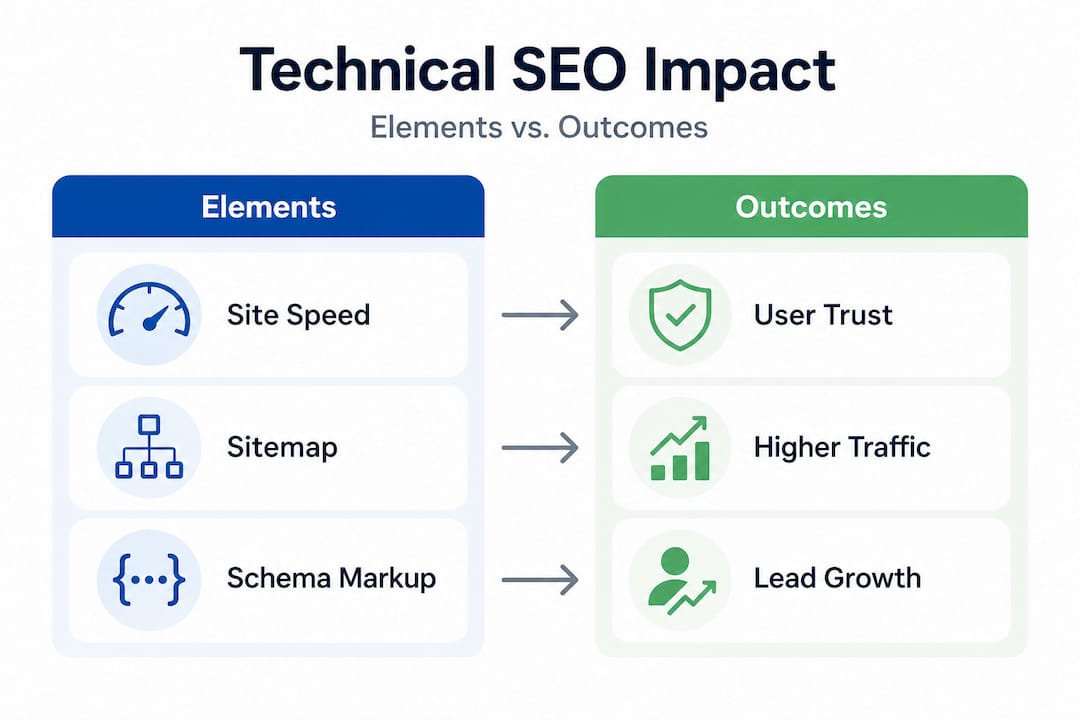
Each of these elements works together. Fix one and you see incremental gains. Fix all of them and you can see the kind of traffic growth that directly translates into revenue.
Key technical SEO areas to understand at a foundational level:
- Site architecture: How your pages link to each other and how easily bots can navigate your site
- Crawlability: Whether search engines can access your pages without hitting blocks or errors
- Mobile-friendliness: Whether your site performs well on smartphones, which now drive the majority of local searches
- Core Web Vitals: Google’s specific speed and stability metrics that influence ranking
- Structured data: Code that tells Google exactly what your content means, enabling rich results
Now that you know why technical SEO stands apart, let’s break down what it means in practical terms.
The anatomy of technical SEO: From crawl to ranking
With the fundamentals clear, let’s explore what actually happens when search engines try to understand and rank your site. The core process includes four stages: Discovery, Crawling, Rendering, and Indexing, with Ranking following as the final outcome. Each stage is a checkpoint. Fail at any one of them and your page never reaches the search results.
Here is what happens at each stage and what you need to check:
-
Discovery: Google finds your pages through links, sitemaps, or direct submission. Check that your XML sitemap is current, submitted to Google Search Console, and includes all important pages. Orphan pages with no internal links pointing to them will never be discovered.
-
Crawling: Googlebot visits your pages and reads the code. Check your robots.txt file to confirm you are not accidentally blocking important pages. Also check for crawl budget waste caused by duplicate pages, parameter URLs, or low-quality pages eating up your crawl allocation.
-
Rendering: Google processes your HTML, CSS, and JavaScript to understand what users actually see. If your site relies heavily on JavaScript to load content, Google may not see that content at all during initial crawl. Check for JavaScript rendering issues using Google’s URL Inspection tool.
-
Indexing: Google decides whether to store your page in its index. Check for noindex tags on pages you want ranked, duplicate content issues, and thin pages that Google may choose to skip.
-
Ranking: Google evaluates hundreds of signals to determine where your page appears in results. At this stage, Core Web Vitals scores, structured data, and overall page quality all play a role.
Using expert strategies to rank on Google means understanding that ranking is the final reward for getting all the earlier stages right. Most businesses only focus on ranking and ignore the pipeline that leads to it.
| Priority Area | Small or Local Site | Large or Enterprise Site |
|---|---|---|
| Crawl budget | Less critical, but still relevant | Critical, requires active management |
| JavaScript rendering | Moderate concern | High priority, often a major blocker |
| Schema markup | High impact for local leads | High impact for product and brand visibility |
| Site speed | High priority | High priority, often requires CDN and caching |
| Duplicate content | Common issue with location pages | Complex, requires canonical strategy |
| Log file analysis | Optional but useful | Essential for diagnosing crawl behavior |
Pro Tip: Do not wait for rankings to drop before auditing your crawl stages. Set up Google Search Console alerts and review your coverage report monthly. Catching a crawl block early can save weeks of lost visibility.
Critical technical SEO priorities for Boca Raton businesses
Understanding the lifecycle is just the start. Here is where Boca Raton businesses should focus for the biggest technical SEO wins.
Boca Raton is a competitive market. You are not just competing with local businesses. You are competing with national brands that have large SEO budgets. That means your technical SEO cannot be an afterthought. It needs to be a deliberate strategy. Following a solid SEO checklist for local strategies gives you a structured starting point, but here are the areas that deliver the most impact.
Crawlability: This is the non-negotiable starting point. Your sitemap must be accurate and submitted. Your robots.txt must not block important pages. Internal linking must connect all key service pages so Google can find and revisit them regularly.

Core Web Vitals with field data: Google measures real user experience through field data, which is collected from actual visitors using Chrome. Lab scores from tools like PageSpeed Insights are useful for diagnosis, but your SEO content for Boca Raton rankings depend on what real users experience. Monitor your Core Web Vitals in Google Search Console under the “Experience” section.
Schema markup for local businesses: Schema is structured data code that tells Google exactly what your business is, where it is located, what services you offer, and what your customers say about you. For local lead generation, LocalBusiness schema, Service schema, and Review schema are the highest-value implementations. They can trigger rich results in search listings, which dramatically increase click-through rates.
JavaScript audit: If your website uses a modern JavaScript framework like React or Vue.js, you need to verify that Google can render your content. Many Boca Raton business websites have entire service pages that Google cannot read because the content only loads after JavaScript executes.
Here is a focused technical SEO priority checklist for local businesses:
- Submit and verify your XML sitemap in Google Search Console
- Audit your robots.txt for accidental blocks on key pages
- Run a Core Web Vitals check using field data in Search Console
- Implement LocalBusiness schema with accurate NAP (name, address, phone) data
- Check for JavaScript rendering issues using the URL Inspection tool
- Identify and fix redirect chains that slow crawling and dilute link equity
- Ensure all key pages are mobile-friendly and load in under 2.5 seconds
The numbers are real. Technical fixes can deliver 20% to 100% or greater increases in traffic and revenue for businesses that have been operating with unresolved technical issues. A Boca Raton service business with crawl errors and missing schema is leaving that growth on the table every single month.
Pro Tip: Focus on field data over lab scores when prioritizing Core Web Vitals fixes. A page that scores 65 in a lab tool but shows green in Search Console field data is performing fine for real users. Prioritize pages with poor field data first, as those directly affect your rankings.
Advanced technical SEO: Nuance, edge cases, and pitfalls
Beyond the basics, technical SEO can get complex fast. Let’s dig into the nuanced issues that trip up even experienced marketers.
Edge cases in technical SEO include orphan pages, pagination sequencing errors, JavaScript rendering blocks, hreflang conflicts, redirect chains, and Cloudflare AI bot blocks. Each of these can silently suppress your rankings without any obvious warning signs.
Here are the most common advanced issues and how to address them:
- Orphan pages: Pages with no internal links pointing to them. Google rarely discovers or revisits these pages. Fix by auditing your site with a crawler like Screaming Frog and adding relevant internal links.
- Redirect chains: Multiple redirects in sequence (A redirects to B, B redirects to C). Each redirect slows crawling and dilutes link equity. Fix by updating redirects to point directly to the final destination URL.
- Pagination errors: If your blog or product pages use pagination, each page needs proper rel=“next” and rel=“prev” tags, or a self-referencing canonical. Errors here cause Google to index only page one or to duplicate content across pages.
- JavaScript rendering blocks: Content that only loads after JavaScript executes may be invisible to Google. Fix with server-side rendering (SSR) or pre-rendering for critical content.
- Hreflang conflicts: If your site targets multiple languages or regions, incorrect hreflang tags cause Google to serve the wrong version to the wrong audience. This is rare for most Boca Raton local businesses but critical for multi-location or multilingual sites.
“Log file analysis is the most underused technical SEO tool available. It shows you exactly which pages Googlebot is crawling, how often, and what it encounters. No other tool gives you this level of real crawl behavior data.”
Log file analysis reveals the true crawl behavior of search bots on your site. Tools like Screaming Frog Log File Analyser or Botify can process your server logs and show you exactly which pages Google visits, how frequently, and whether it encounters errors. This is especially valuable for larger sites or any site that has undergone a migration.
The AI bot issue is increasingly important in 2026. AI training bots from companies like Common Crawl and others are consuming server bandwidth and crawl resources. You can and should block these bots in your robots.txt. The key is to block only training bots while keeping search engine bots like Googlebot, Bingbot, and others fully accessible. A proper website optimization checklist includes reviewing your robots.txt for AI bot directives as a standard step.
Blocking AI bots incorrectly is a real risk. Some businesses use blanket bot-blocking rules that accidentally block legitimate search crawlers. Always test your robots.txt changes using Google Search Console’s robots.txt tester before deploying them to production.
A Boca Raton expert’s perspective: What most businesses get wrong
Here is the uncomfortable truth we see repeatedly with Boca Raton businesses. They invest in content. They chase backlinks. They hire someone to optimize their meta descriptions. And then they wonder why rankings plateau after a few months of initial progress.
The answer is almost always technical SEO. Specifically, it is the technical issues they never fixed because they assumed content and links were enough.
We have seen this scenario play out with local service businesses across Boca Raton. A company invests months into content marketing. Traffic grows slightly. Then it stalls. When we audit the site, we find a robots.txt file blocking entire sections of the site, Core Web Vitals scores in the red for mobile users, and zero schema markup on their service pages. These are not exotic problems. They are common, fixable, and expensive to ignore.
The fastest lead growth we have seen from any single SEO action came from fixing a crawlability issue combined with adding LocalBusiness schema. One local business went from page three to the top three results within six weeks of those two fixes alone. No new content. No new backlinks. Just technical corrections that allowed Google to finally understand and trust the site.
Here is the contrarian insight most agencies skip: technical SEO is not a one-time audit. It is a continuous monitoring practice. Google updates its crawling behavior. Sites change. New pages get added. Redirects accumulate. What was technically clean six months ago may have new issues today. The businesses that consistently generate leads from search are the ones treating technical SEO as an ongoing discipline, not a box to check once.
The real multiplier effect is this: technical SEO amplifies everything else. Strong content on a technically sound site ranks faster and holds rankings longer. Backlinks to a crawlable, fast-loading site pass more equity. Schema on a properly indexed page generates rich results that content alone cannot produce. Skip technical SEO and you cap the ceiling on every other investment you make in search visibility.
Ready to amplify your Boca Raton lead generation?
If this guide has made one thing clear, it is that technical SEO is not optional for businesses serious about generating leads from Google. It is the foundation that determines whether all your other SEO work actually pays off.

We rank #1 on Google for our own target keywords, which means we practice exactly what we teach. Our team specializes in SEO for lead generation with a focus on high buyer intent searches that convert into real business. We can get your site ranking multiple times on page one, pushing competitors off entirely. Start by downloading our local SEO checklist to see where you stand, or grab your free SEO report to get a personalized assessment of your technical SEO health today.
Frequently asked questions
What is the difference between technical and on-page SEO?
Technical SEO focuses on website infrastructure to support search engine bots, covering crawlability, site speed, and structured data, while on-page SEO targets visible content, keywords, and meta descriptions for users.
Which technical SEO action gives the fastest lead boost?
Fixing crawlability issues using accurate sitemaps and a clean robots.txt file typically delivers the quickest improvement in local rankings, since crawlability fixes unlock 20% to 100% or greater traffic gains in documented cases.
How do I check if AI bots are hurting my SEO?
Use log file analysis to identify which bots are crawling your site, then update your robots.txt to block AI training bots while keeping Googlebot and other legitimate search crawlers fully accessible.
Can technical SEO really increase my leads and sales?
Effective technical SEO fixes can deliver 20% to 100% or greater increases in traffic and leads for local businesses, especially when crawlability, Core Web Vitals, and schema markup are all addressed together.