
Most Boca Raton businesses treat SEO like a keyword puzzle. Pick the right words, stuff them into a page, and wait for Google to reward you. That’s not how it works anymore. Search engine algorithms operate through three core phases and evaluate hundreds of signals simultaneously. The businesses that win on page one aren’t guessing. They’re working with systems designed to reward real expertise, genuine content, and strong user experience. If you want high-quality leads flowing from Google searches in Boca Raton, you need to understand what’s actually happening behind the results.
Table of Contents
- How search engines work: From crawling to ranking
- What powers the results: Modern Google ranking systems explained
- Key ranking signals: What Google really values in 2026
- Advanced nuances and expert tips: Avoiding algorithm pitfalls in 2026
- Our perspective: Why local experience wins in algorithm-driven SEO
- Achieve SEO success with Boca Raton’s experts
- Frequently asked questions
Key Takeaways
| Point | Details |
|---|---|
| Algorithms are dynamic | Search engines update algorithms constantly, affecting business rankings and visibility. |
| E-E-A-T trumps old tactics | Google now rewards local expertise, author bios, and unique content over traditional keyword strategies. |
| High-quality user experience matters | UX metrics and engagement are crucial ranking signals businesses can control. |
| Avoid AI content pitfalls | Scaled or generic AI content can result in severe penalties, while unique local data boosts results. |
How search engines work: From crawling to ranking
Search engines don’t just magically know what’s on your website. They send out automated programs called crawlers, or bots, to scan every corner of the web. Think of crawlers like postal workers constantly checking new addresses and updated mailboxes. When your website publishes new content or updates an existing page, Google’s crawlers eventually find it and report back.
Here’s how the full process breaks down:
- Crawling: Google’s bots follow links from page to page, discovering new and updated content across billions of URLs. If your site isn’t properly linked or is blocked by technical errors, crawlers can’t find you.
- Indexing: Once a page is crawled, Google organizes and stores the information in its index. This is where content is analyzed for meaning, structure, and context using natural language processing.
- Ranking: When a user searches, Google ranks results by evaluating hundreds of signals including relevance, E-E-A-T (Experience, Expertise, Authoritativeness, Trustworthiness), backlinks, and user experience data.
The three phases are crawling, indexing, and ranking, and together they form the backbone of how search results are generated.
| Phase | What happens | Why it matters |
|---|---|---|
| Crawling | Bots scan and discover pages | Content must be accessible and linked |
| Indexing | Content is stored and analyzed | Structure and clarity improve indexing |
| Ranking | Signals are evaluated for results | Strong signals equal higher placement |
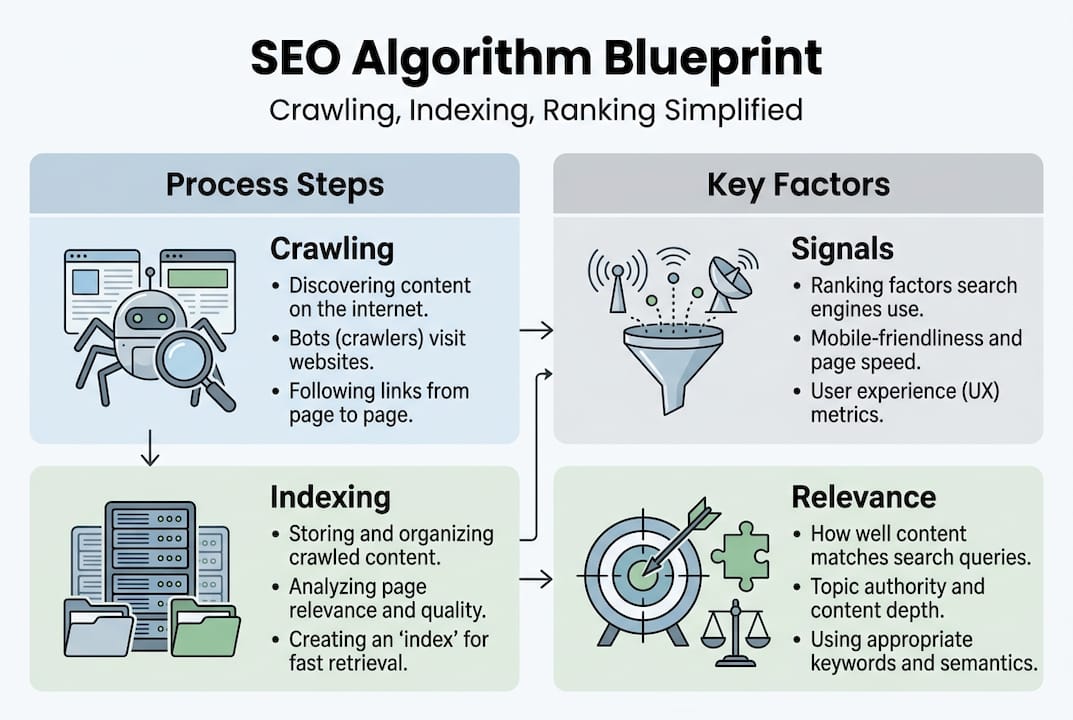
The scale of this operation is staggering. Google processes over 99,000 queries per second and uses hundreds of signals for ranking. That means every second of every day, Google is making decisions about which businesses show up and which ones don’t. For Boca Raton businesses competing for high-intent searches, understanding these phases is the first step toward getting noticed.
The ranking phase is where most businesses win or lose. It’s not enough to be indexed. You have to give Google the right signals to earn a top position. Every technical decision on your site, every piece of content you publish, and every backlink you earn feeds directly into this ranking evaluation.
What powers the results: Modern Google ranking systems explained
Now that the core processes are clear, we can look at what really powers search rankings today. Google doesn’t rely on a single algorithm. It uses multiple overlapping systems that each analyze different aspects of a web page.
Google’s ranking systems include Core, SpamBrain, Helpful Content, RankBrain, BERT, MUM, Gemini, PageRank, and Core Web Vitals. Each one handles a specific job. RankBrain interprets user intent. BERT and MUM understand conversational language and complex queries. SpamBrain filters out manipulative or low-quality content. Core Web Vitals measures how fast and stable your pages load.
Key systems and their roles:
- RankBrain and BERT/MUM/Gemini: Process the meaning behind search queries, matching intent rather than just keywords
- PageRank: Evaluates the quality and authority of backlinks pointing to your site
- Helpful Content System: Rewards content written for people, not search bots
- Core Web Vitals: Scores page speed, visual stability, and interactivity
- SpamBrain: Penalizes sites using manipulative tactics or low-value AI-generated content
A critical shift happened with the March 2026 Core Update, which changed priorities across over 200 to 500 ranking factors, elevating E-E-A-T as a central concept since 2022. This means Google now rewards businesses that demonstrate real-world experience, not just content volume.
| Factor | Bing | |
|---|---|---|
| Algorithm updates | Continuous AI evaluation | Periodic scheduled updates |
| E-E-A-T emphasis | Central to all rankings | Growing but less dominant |
| Local ranking signals | Highly refined | Less granular |
| AI content detection | Advanced and aggressive | Developing |
For local businesses in Boca Raton, this shift is actually an opportunity. You have local stories, client results, and community knowledge that national competitors can’t replicate. Use them. Leverage your local SEO ranking checklist to make sure your site communicates that local expertise clearly. Strong SEO content visibility starts with aligning your content to what these systems are designed to reward.
Pro Tip: Update your Google Business Profile regularly and include recent client testimonials with specific results. Google’s systems pick up on freshness and trust signals, giving local businesses a real edge.
Key ranking signals: What Google really values in 2026
With an understanding of Google’s underlying systems, it’s essential to pinpoint the specific signals that tip the scales for visibility. These are the factors that separate businesses ranking on page one from those buried on page three.
The top ranking signals in 2026:
- Relevance and intent match: Google uses natural language processing to evaluate whether your content truly answers what users are searching for, not just whether it contains the right words
- E-E-A-T signals: Local credentials, author bios, case studies, and customer reviews all build the trust profile Google evaluates
- Backlink quality: Links from authoritative local and industry sources act like votes of trust. One strong backlink from a respected source outweighs dozens of low-quality ones
- Core Web Vitals: Page speed, layout stability, and interactivity directly affect both rankings and user behavior
- Content freshness: Regularly updated pages signal that your business is active and your information is current
- Engagement signals: Bounce rate, time on page, and click-through rate all feed into how Google perceives your content’s value
E-E-A-T is now the #1 ranking signal after the post-2025 and 2026 core changes. This is a fundamental shift from keyword-first strategies. Meanwhile, sites prioritizing E-E-A-T gained significant traffic, while those relying on AI-scaled or thin content lost up to 87% of their traffic after recent updates. That’s not a small dip. That’s a business-altering drop.

For Boca Raton businesses, this means your website optimization for leads needs to center on demonstrating real expertise. Add your team’s credentials. Publish case studies with actual numbers. Make it clear that real people with real experience are behind your brand.
Pro Tip: For SEO lead generation, focus on high-intent keywords like “best [service] in Boca Raton” paired with strong E-E-A-T signals. That combination consistently drives leads that convert.
Advanced nuances and expert tips: Avoiding algorithm pitfalls in 2026
Beyond the basics, there are subtle but crucial nuances and risks that can make or break your SEO efforts in 2026. Many businesses make well-intentioned moves that end up triggering penalties or stalling growth.
Key risks to watch in 2026:
- AI-generated content at scale: Publishing large volumes of AI content without human editing or unique insights is now aggressively penalized
- YMYL pages without trust signals: Pages covering health, finance, legal, or safety topics (Your Money or Your Life) face stricter scrutiny and require clear author expertise and source citations
- Generic programmatic content: Automatically generated pages that don’t offer unique value are filtered out, not rewarded
- Ignoring personalization: Google tailors results based on location, device, search history, and more. If your core signals are weak, personalization filters push you further down
“AI content is penalized if thin or produced at scale. Unique data and genuine experience signals gain the advantage.”
Local author bios, fresh case studies, and structured data improve E-E-A-T and local rankings significantly. This means adding a real name, a photo, and a brief credential section to your content pages isn’t optional anymore. It’s a ranking factor.
For programmatic or data-driven SEO to work, each page must offer something genuinely unique. A location page that simply swaps out city names without tailored content will not rank. Google is smart enough to detect templates.
Pro Tip: Add structured data markup (schema) to your service pages and author profiles. This helps Google extract and display your expertise directly in search results, which boosts both rankings and click-through rates. Local businesses working with local SEO expertise see measurable improvements from this single technical move.
Our perspective: Why local experience wins in algorithm-driven SEO
Here’s the truth that most SEO guides won’t say plainly: the businesses ranking at the top of Google in 2026 aren’t there because they cracked a code. They’re there because they stopped chasing algorithms and started building real authority.
We’ve watched the SEO landscape shift dramatically over the past several years. The agencies still selling keyword stuffing, backlink farms, and templated content are setting their clients up for penalties, not page one. Google’s march toward E-E-A-T and AI-powered evaluation has made one thing clear. Authenticity is the algorithm.
Local businesses in Boca Raton have a genuine advantage here. You have customer stories, community connections, and real results that no national competitor can manufacture. Showcasing that local expertise, featuring real client outcomes, and keeping your content current sends signals that Google’s systems are specifically designed to reward.
SEO is no longer a one-time checklist. It’s an ongoing investment in your business’s authority. The agencies and businesses that treat it that way are the ones generating consistent lead generation insights month after month. Start there, and the rankings follow.
Achieve SEO success with Boca Raton’s experts
Understanding how search algorithms work is powerful. Applying that knowledge to outrank your competitors and fill your pipeline with qualified leads is where real growth happens.

Our team specializes in high-intent lead generation for Boca Raton businesses, targeting the searches that translate directly into revenue. We use proven strategies to get your business ranking on page one, and we back it up with our own results. Use our local SEO checklist to evaluate where you stand today. When you’re ready to take the next step, the Boca Raton SEO experts at our agency are here to build your visibility advantage and make it last.
Frequently asked questions
What are the three main phases of a search engine algorithm?
Crawling, indexing, and ranking are the three phases used by search engines to process and order web content. Each phase builds on the previous one, making all three critical for visibility.
Why is E-E-A-T so important for local SEO in 2026?
Google’s latest updates prioritize experience, expertise, authoritativeness, and trustworthiness above almost every other signal. E-E-A-T is now the #1 ranking signal after the core updates, making it essential for local businesses competing on Google.
Can AI-generated content help or hurt search rankings?
High-quality, unique AI-assisted content can support rankings, but scaled or thin AI content is aggressively penalized under the March 2026 updates. Human oversight and original insights are non-negotiable.
How do user experience signals affect SEO rankings?
Metrics like Core Web Vitals and engagement are now major ranking factors shaping a business’s online visibility. A slow or unstable site directly costs you rankings regardless of content quality.
What is the biggest mistake Boca Raton businesses make with SEO?
The most common mistake is relying on outdated tactics like keyword stuffing instead of building real trust signals. Prioritize local expert authors and genuine case studies to align with what Google actually rewards in 2026.