
Most Boca Raton business owners assume keyword ranking works like a simple scoreboard: you either rank or you don’t. The reality is far more complex. Google personalizes results based on your location, search history, and device, meaning two people searching the same term in the same city can see completely different results. This guide breaks down exactly what keyword ranking is, how Google actually decides who appears on page one, and what local businesses need to do right now to turn better rankings into real, qualified leads. If you’ve been chasing positions on a rank tracker and wondering why the phone isn’t ringing, this is for you.
Table of Contents
- What is keyword ranking and how does Google determine results?
- Traditional keyword ranking vs. Google’s semantic search
- Why keyword ranking matters for Boca Raton businesses
- How to improve keyword ranking for local SEO success
- The uncomfortable truth about keyword ranking in 2026
- Take the next step to grow your business with local SEO
- Frequently asked questions
Key Takeaways
| Point | Details |
|---|---|
| Keyword ranking basics | Keyword ranking means where your website shows up for specific search terms on Google. |
| Semantic search impact | Google now prioritizes search intent and context rather than exact keyword matches. |
| Maps visibility boost | Optimizing local keywords can increase Google Maps views by over 150% for Boca Raton businesses. |
| Intent-driven SEO | Targeting keywords that match local search intent attracts higher-quality leads. |
| Practical improvement steps | Optimizing content, website, and local profiles leads to sustainable ranking gains. |
What is keyword ranking and how does Google determine results?
Keyword ranking refers to where a specific webpage appears in Google’s search results for a given search term. If someone searches “best plumber in Boca Raton” and your website shows up third, you hold the number three keyword ranking for that query. Simple enough on the surface. But the way Google assigns those positions has changed dramatically over the past few years.
Traditionally, ranking was straightforward. Google crawled your page, found the exact phrase you were targeting, and matched it to the user’s query. If your page said “best plumber in Boca Raton” enough times, you had a solid shot at ranking. That era is mostly gone.
Today, Google uses natural language processing (NLP), which allows it to understand the meaning and intent behind a search, not just the exact words used. So if someone searches “top-rated plumbing near me” or “affordable plumber Boca Raton,” Google understands these are all pointing to the same need. This is why local SEO reports often show rankings fluctuating even when your content hasn’t changed.
Here’s a quick look at what Google evaluates when ranking a local page:
| Ranking Factor | What It Measures |
|---|---|
| Content relevance | Does the page match search intent? |
| Backlink authority | How many quality sites link to you? |
| User experience | Page speed, mobile-friendliness, engagement |
| Local signals | Citations, reviews, Google Business Profile |
| Personalization | User’s location, history, and device |
Key factors that influence where you rank include:
- Search intent alignment: Is your page answering what the user actually wants?
- Geographic proximity: Is your business close to where the searcher is located?
- Device type: Mobile rankings often differ from desktop rankings
- Search history: Prior behavior shapes what Google shows each user
- Page authority: How trusted is your site overall?
Pro Tip: Never rely on just one keyword tracking tool. Tool accuracy varies by location and personalization, so cross-reference your data with Google Search Console for a clearer picture of how you’re actually performing.
Traditional keyword ranking vs. Google’s semantic search
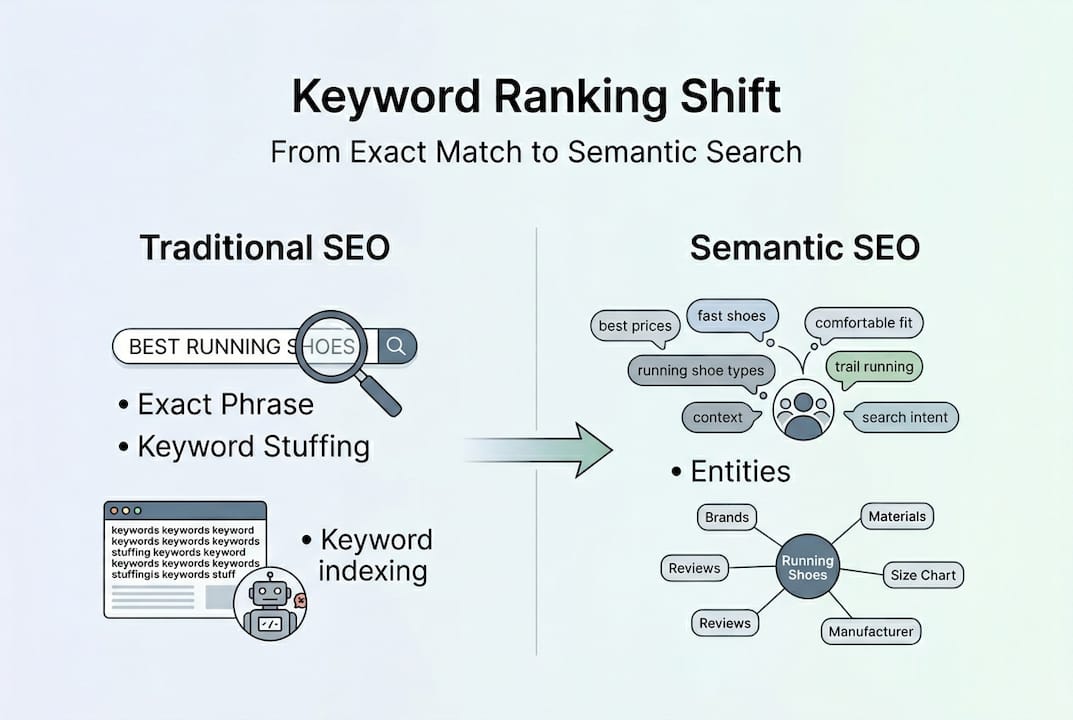
To understand where local SEO is headed, it helps to see where it started. Traditional keyword ranking was built on exact-match logic. You targeted a phrase, optimized your page around that phrase, and watched your position climb or fall. It was mechanical, and honestly, easy to game.
Semantic search changed everything. Google understands synonyms via NLP, which means the search engine now interprets what users mean, not just what they type. This is a fundamental shift in how rankings work.
Here’s a direct comparison:
| Feature | Traditional Ranking | Semantic Search |
|---|---|---|
| Match type | Exact-match phrase | Intent and meaning |
| Content strategy | Keyword density | Topic relevance |
| Local results | Location-tagged pages | Entity-based listings |
| Tracking accuracy | High for static queries | ~90% with local variance |
| Personalization | Minimal | Significant |
“The shift from keyword matching to semantic understanding means that ranking for one phrase can earn you visibility for dozens of related searches. That’s the real opportunity for local businesses.”
For Boca Raton businesses, this shift is both a challenge and an opportunity. The challenge is that exact-match tactics no longer guarantee results. The opportunity is that boosting visibility with content that covers a topic thoroughly can earn you rankings for many related searches at once.

Entity-based ranking is another piece of this puzzle. Google increasingly understands businesses as entities, not just websites. Your Google Business Profile, your name and address consistency across the web, and your category selections all contribute to how Google places you in local Map Pack results. This is why off-page SEO for local business matters as much as what’s on your website.
The practical takeaway: stop optimizing for one keyword and start building content ecosystems around topics that match what your best customers are actually searching for.
Why keyword ranking matters for Boca Raton businesses
Ranking well isn’t about bragging rights. It’s about revenue. When your business appears at the top of search results for terms that your ideal customers are using, you generate traffic that converts. That’s the core of what makes local SEO so powerful for Boca Raton businesses.
📊 Stat callout: Optimized keyword strategies yield 156% more visibility in Google Maps for local businesses. That’s not a small bump. That’s the difference between being found and being invisible.
The reason this matters so much for Maps is that the majority of local searches result in a Map Pack appearing above the organic results. If you’re not ranking in that section, you’re missing customers before they even scroll down to your website.
Here’s what strong keyword ranking delivers for local businesses:
- More qualified traffic: People searching specific local terms are usually ready to act
- Higher conversion rates: Relevant queries attract buyers, not browsers
- Increased brand trust: Top rankings signal authority to potential customers
- Competitive advantage: Pushing competitors off page one protects your lead volume
- Compounding growth: Rankings that hold generate leads month after month
This is where attracting high-intent leads becomes your actual business strategy. Not all search traffic is equal. Someone searching “emergency roof repair Boca Raton” is ready to hire right now. That kind of search intent translates directly into phone calls and booked appointments.
Pro Tip: Focus your initial keyword strategy on terms with strong buyer intent rather than high search volume. A keyword with 200 monthly searches and clear purchase intent will outperform a 2,000-volume keyword from someone just browsing.
Understanding ranking on Google locally means understanding that position one for the right keyword beats position ten for a popular but vague one every single time.
How to improve keyword ranking for local SEO success
Knowing why rankings matter is only useful if you know how to actually improve them. Here’s a proven, step-by-step approach tailored specifically for Boca Raton business owners.
-
Research your best local keywords: Use tools like Google Keyword Planner or Semrush to find terms your ideal customers are typing. Focus on location-specific phrases and buyer-intent modifiers like “near me,” “best,” “affordable,” and “hire.”
-
Match each page to one clear intent: Every page on your site should target a specific intent. A service page for “air conditioning repair Boca Raton” should answer repair-related questions, not general HVAC information. Pair keyword optimization with content matching intent for quality leads.
-
Optimize on-page elements: Your title tag, meta description, H1 heading, and first paragraph should all reflect your target keyword naturally. Don’t stuff. Write for people first, then optimize.
-
Build local signals consistently: Submit your business to local directories, ensure your name, address, and phone number (NAP) are identical everywhere, and actively collect Google reviews. These signals reinforce your local authority.
-
Optimize your Google Business Profile: Choose the right categories, write a keyword-rich description, post updates regularly, and respond to every review. This directly influences your Map Pack ranking.
-
Track and adjust: Use the local SEO checklist and website optimization tips to audit your progress monthly and adapt your strategy based on what’s working.
Pro Tip: Ranking improvements take time. Review the SEO timeline for results so you can set realistic expectations and avoid making premature changes that reset your progress.
Consistency is the engine here. Businesses that show up, optimize regularly, and build local authority over months are the ones that dominate local search.
The uncomfortable truth about keyword ranking in 2026
Here’s something most SEO agencies won’t tell you: the ranking number you see in your tracking tool may not reflect what your customers actually see. Tool accuracy is around 90% but varies based on local signals and personalization. That 10% gap can represent real leads you’re missing or competitors you’re underestimating.
The bigger issue is that many business owners fixate on ranking for specific keywords rather than building genuine search visibility. Chasing a single position on a single keyword is like measuring a restaurant’s success by one Yelp review. It tells you something, but not the whole story.
What actually moves the needle is building a local SEO presence that covers your topic thoroughly, earns trust from Google through consistent signals, and matches the real intent behind what buyers search. Rankings follow from that foundation. They are a byproduct of doing SEO right, not the goal itself.
Understanding SEO timelines shifts your mindset from “where do I rank today” to “am I generating more qualified leads this month than last month.” That’s the question that grows businesses.
Take the next step to grow your business with local SEO
You now understand how keyword ranking works, why it matters in Boca Raton, and what it takes to improve it. The next move is applying that knowledge with the right strategy behind it.
We help Boca Raton businesses generate high-intent leads by targeting the keywords that buyers actually use, ranking on page one, and pushing competitors out of the way. We rank #1 ourselves, which means we know exactly how to get you there too. Start with a personalized SEO report to see where your business stands today, or use our Boca Raton visibility checklist to identify your fastest opportunities. Real rankings. Real leads. Let’s build it.
Frequently asked questions
Can keyword ranking be accurately tracked for local searches in Boca Raton?
Tracking accuracy is around 90% but shifts based on personalization and local factors, so always validate rank data against Google Search Console.
How does Google Maps visibility relate to keyword ranking?
Optimized local keywords push your business into Map Pack results more frequently, with 156% more Maps visibility reported for businesses that prioritize the right search terms.
Why is matching content to keyword intent important?
When your page directly answers what a searcher needs, Google rewards it with better placement, and content aligned with intent attracts buyers who are ready to convert rather than casual visitors.
Should Boca Raton businesses focus more on rankings or visibility?
Visibility and lead generation are what actually grow revenue. Rankings are useful indicators, but as personalization increases, a broader visibility strategy will outperform chasing one specific position.
Recommended
- How to rank on Google: expert strategies for Boca Raton businesses
- SEO checklist: local strategies to boost Boca Raton visibility
- SEO Content Explained: Boost Visibility & Leads in Boca Raton
- Website optimization checklist for Boca Raton: boost leads
- Understanding search rankings: boost your South African SMB SEO